What Is Ridge Push: Definition, How It Works, and Role in Plate Tectonics
Understanding what is ridge push is essential for anyone studying geography, geology, or the movement of Earth’s tectonic plates. Ridge push is a natural geological force that contributes to the movement of oceanic plates away from mid-ocean ridges. These underwater mountain systems are where new oceanic crust is created through volcanic activity, and the process plays a major role in shaping the planet’s surface over millions of years.
The movement of tectonic plates is not controlled by a single force but by a combination of different geological processes. Ridge push is one of the important mechanisms that helps explain how plates move across the Earth’s surface. Although the term suggests that a ridge physically pushes a plate forward, the actual process is mainly caused by gravity acting on elevated oceanic crust.
What Is Ridge Push and Its Basic Definition
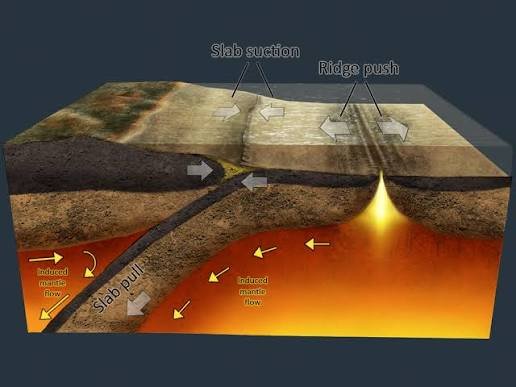
What is ridge push can be explained as a gravity-driven force that occurs when newly formed oceanic crust moves away from a raised mid-ocean ridge. At divergent plate boundaries, magma rises from the Earth’s mantle and cools to create new oceanic lithosphere. Because this new crust is hotter and less dense than older oceanic crust, it sits at a higher elevation near the ridge.
As the oceanic crust moves away from the ridge, it cools, becomes denser, and sinks slightly lower. The difference in height between the elevated ridge and the surrounding ocean floor creates a gravitational force. This force causes the plate to slowly slide away from the ridge, producing what scientists call ridge push.
The name ridge push can sometimes create confusion because it does not involve the ridge physically pushing the plate like a moving object. Instead, gravity pulls the higher section of the plate down the slope, creating a movement that contributes to seafloor spreading and plate tectonics.
How Ridge Push Works in Plate Tectonics
The process behind ridge push begins at mid-ocean ridges, which are long underwater mountain ranges formed by tectonic activity. At these locations, two tectonic plates move apart, allowing magma from the mantle to rise through cracks in the Earth’s crust. When the magma reaches colder ocean water, it quickly cools and forms new solid rock.
This newly formed oceanic crust creates a higher area around the ridge because it is still warm and expanded. Over time, the crust moves away from the ridge, loses heat, becomes more compact, and increases in density. Gravity then causes the older and heavier sections of the plate to move downward, helping drive the plate away from the spreading centre.
Ridge push works gradually over geological time periods. The movement may seem extremely slow from a human perspective, but over millions of years it can significantly change the position of continents, reshape ocean basins, and influence the arrangement of Earth’s landmasses.
The Connection Between Ridge Push and Seafloor Spreading
Seafloor spreading is one of the key processes connected with ridge push. It occurs when new oceanic crust forms at divergent boundaries and spreads outward in opposite directions. This process provides evidence for plate tectonics and helps explain how the ocean floor is constantly renewed.
At spreading centres, the youngest oceanic crust is found close to the mid-ocean ridge, while older crust is located further away. This pattern shows how plates gradually move across the ocean floor. Ridge push contributes to this movement by helping newly created crust slide away from the elevated ridge area.
The relationship between ridge push and seafloor spreading demonstrates how Earth’s internal heat and surface processes work together. Without these geological forces, the movement of tectonic plates would be very different, and many of the features we see on Earth today would not exist.
The Role of Mid-Ocean Ridges in Ridge Push
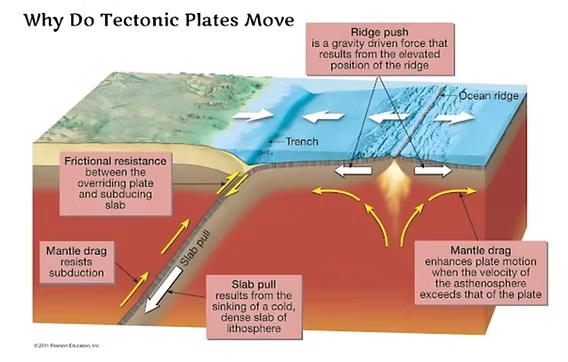
Mid-ocean ridges are the main locations where ridge push occurs. These massive underwater mountain systems stretch across thousands of kilometres and mark areas where tectonic plates separate. They are among the most active geological regions on Earth because they continuously produce new oceanic crust.
One well-known example is the Mid-Atlantic Ridge, which runs through the Atlantic Ocean and separates several tectonic plates. New crust forms along this ridge, gradually moving outward as part of the natural spreading process. The elevated shape of the ridge creates the conditions needed for gravitational sliding and ridge push.
These underwater structures provide scientists with valuable information about Earth’s history and the movement of continents. By studying mid-ocean ridges, researchers can understand how ocean floors develop and how tectonic forces have shaped the planet over billions of years.
Ridge Push and Other Forces That Move Tectonic Plates
Although ridge push is an important part of plate movement, it is not the only force responsible for tectonic activity. Earth’s plates are influenced by several processes, including slab pull and mantle convection. Together, these forces create the complex system that drives plate tectonics.
Slab pull occurs at subduction zones where a dense oceanic plate sinks beneath another plate and pulls the rest of the plate behind it. Many scientists consider slab pull to be a stronger force than ridge push because sinking plates can create significant movement. However, ridge push still provides an important contribution by helping plates move away from spreading centres.
Mantle convection has also been discussed as a possible contributor to plate movement. Although its exact influence is still studied, scientists agree that the interaction between different forces creates the dynamic movement of Earth’s crust.
Ridge Push vs Slab Pull: Understanding the Difference
The difference between ridge push and slab pull is an important concept in Earth science. Ridge push happens at divergent boundaries, where plates move apart and new crust forms at mid-ocean ridges. It is mainly driven by gravity acting on elevated oceanic crust.
Slab pull occurs at convergent boundaries where one tectonic plate sinks into the mantle. The weight and density of the sinking plate create a pulling force that moves the rest of the plate. While ridge push helps plates move away from ridges, slab pull draws plates towards subduction zones.
Understanding both processes helps explain why tectonic plates move in different directions around the world. These forces work together to create earthquakes, volcanic activity, mountain formation, and changes in ocean landscapes.
Importance of Ridge Push in Earth Science
Ridge push is important because it helps scientists understand how the Earth’s surface changes over time. By studying this force, researchers can explain the formation of ocean basins, the movement of continents, and the behaviour of tectonic plates.
For geography students, understanding what is ridge push provides a clearer picture of plate tectonics and natural processes that shape the planet. It is a key topic in Earth science because it connects underground activity with visible changes on Earth’s surface.
The study of ridge push also helps scientists investigate ancient geological events. By analysing ocean crust patterns and plate movements, researchers can learn more about Earth’s past and predict how geological processes may continue in the future.
Conclusion
Ridge push is a fascinating geological process that explains how gravity helps move tectonic plates away from mid-ocean ridges. By understanding what is ridge push, we can better understand the relationship between new oceanic crust formation, seafloor spreading, and global plate movement.
Although ridge push is only one part of the larger plate tectonic system, it plays an important role in shaping Earth’s surface. Together with forces such as slab pull and mantle processes, ridge push continues to influence the changing structure of our planet.
Frequently Asked Questions
What is ridge push in simple terms?
Ridge push is a gravitational force that causes oceanic plates to move away from elevated mid-ocean ridges.
How does ridge push happen?
Ridge push happens when newly formed oceanic crust cools and slides away from a mid-ocean ridge because of gravity.
Where does ridge push occur?
Ridge push occurs mainly at mid-ocean ridges located at divergent plate boundaries.
Is ridge push the same as seafloor spreading?
No, seafloor spreading creates new oceanic crust, while ridge push helps move that crust away from the ridge.
Why is ridge push important in geography?
Ridge push helps explain tectonic plate movement, ocean formation, and many geological changes on Earth.
You May Also Read: Peasgood Nonsuch Apple