
Edward Godwin: Biography, Architectural Works, and Lasting Legacy

Edward Godwin was a pioneering British architect and designer whose creative work helped reshape Victorian architecture, furniture, and interior decoration. Born during the nineteenth century, he developed a distinctive approach that challenged traditional decorative conventions and embraced new artistic influences. His designs combined thoughtful proportions, practical functionality, and visual elegance, creating an alternative to the heavily ornamented interiors popular during his lifetime. Today, Edward Godwin remains an important figure in British design history, particularly for his contribution to the Aesthetic Movement and the development of Anglo-Japanese furniture.
The significance of Edward Godwin extends beyond individual buildings and decorative objects. His willingness to experiment with international artistic influences demonstrated how architecture and furniture could evolve through cultural exchange and creative exploration. By incorporating Japanese-inspired principles into British design, he helped establish a fresh visual language characterised by simplicity, asymmetry, and carefully balanced forms. Exploring his biography, architectural achievements, furniture designs, and artistic legacy reveals why his work continues to interest historians, collectors, architects, and interior designers.
Who Was Edward Godwin?
Edward William Godwin was born on 26 May 1833 in Bristol, England. Growing up during a period of rapid industrial development and architectural change, he entered a professional environment dominated by historical revival styles, elaborate decoration, and renewed interest in craftsmanship. His early architectural career developed during the Victorian era, when designers were exploring different ways to combine traditional building methods with contemporary needs. Godwin gradually established himself as an independent thinker who was willing to challenge established conventions and experiment with alternative approaches to architectural expression.
Throughout his career, Godwin demonstrated an interest in several creative disciplines rather than restricting himself to architecture alone. He explored furniture design, interior decoration, theatrical environments, and costume design, allowing ideas from one field to influence another. This multidisciplinary approach distinguished him from designers who concentrated on a single specialism. His ability to move between different artistic practices helped him develop a coherent design philosophy centred on proportion, visual harmony, and the relationship between objects and their surroundings.
Edward Godwin’s Architectural Career and Major Works
Architecture provided the foundation for Godwin’s professional reputation. One of his most notable projects was Northampton Guildhall, developed during the early 1860s. The building reflects the Gothic Revival influences that remained influential throughout Victorian Britain, demonstrating his ability to work within established architectural traditions while developing his own creative identity. The project also illustrates the importance of public architecture during this period, when civic buildings communicated local identity, institutional authority, and growing confidence in British towns.
As his career progressed, Godwin became increasingly interested in alternative approaches to design. Rather than relying exclusively on elaborate historical ornamentation, he explored more restrained forms and considered how proportion, structure, and decorative details could work together. His architectural interests evolved alongside his furniture and interior design experiments, creating connections between his different professional activities. Studying Edward Godwin’s architectural works therefore provides a valuable understanding of the broader changes taking place in nineteenth-century British architecture and decorative arts.
Edward Godwin and the Anglo-Japanese Style
The growing British fascination with Japanese art during the nineteenth century significantly influenced Godwin’s creative development. Japanese ceramics, prints, textiles, furniture, and decorative objects introduced European audiences to different approaches to composition, materials, and ornamentation. Designers increasingly recognised the visual power of asymmetry, open space, and simplified forms. Godwin became particularly interested in adapting these principles to British domestic interiors, helping develop a distinctive style that combined Japanese-inspired aesthetics with contemporary European requirements.
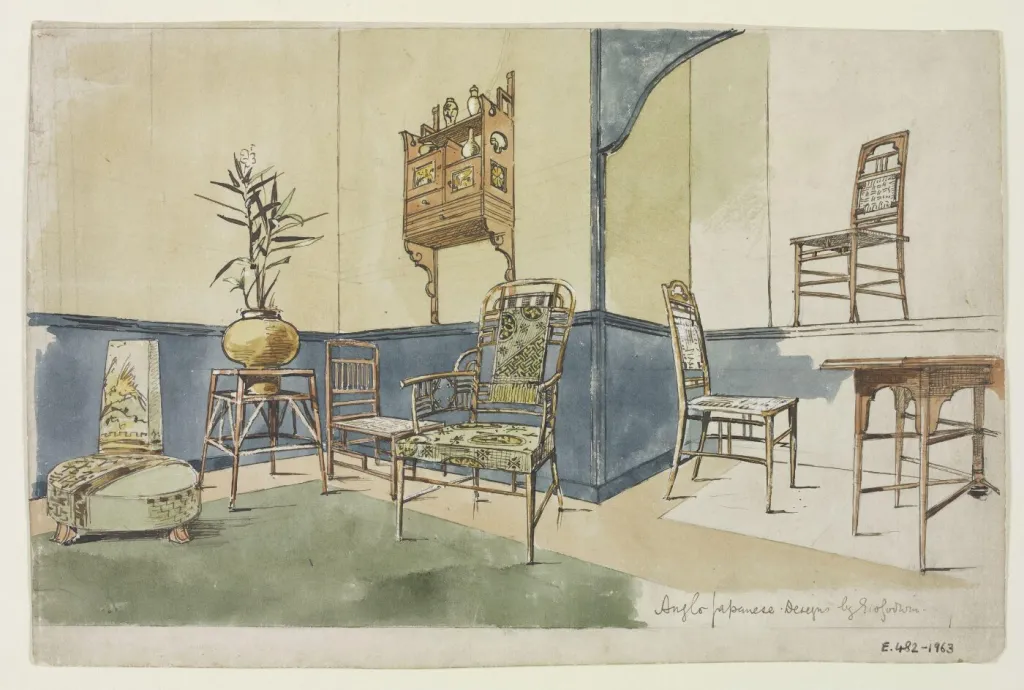
Edward Godwin’s Anglo-Japanese designs often featured geometric structures, slender proportions, dark finishes, and carefully controlled decoration. Rather than reproducing Japanese objects without alteration, he interpreted selected elements to create furniture suitable for British homes. This approach reflected the wider Aesthetic Movement, which encouraged designers to prioritise beauty, artistic individuality, and visual harmony. His work demonstrated that international influences could transform familiar domestic objects, offering an alternative to the heavy furnishings and elaborate decorative schemes associated with conventional Victorian interiors.
Edward Godwin’s Furniture and Interior Design
Furniture became one of the most recognisable aspects of Godwin’s artistic legacy. He designed chairs, tables, cabinets, sideboards, and other domestic objects that combined practical use with distinctive visual character. His designs often relied on clear structural lines, balanced proportions, and restrained ornamentation rather than excessive decoration. These characteristics made his furniture particularly suited to interiors influenced by the Aesthetic Movement, where individual objects were expected to contribute to the overall atmosphere and artistic unity of a room.
Godwin’s Japanese-inspired furniture demonstrated how functionality and visual elegance could coexist. His celebrated Anglo-Japanese sideboard, for example, reflects the interest in geometric forms and distinctive structural arrangements associated with his design philosophy. His work encouraged a different understanding of domestic furniture, presenting tables, cabinets, and seating as carefully considered artistic creations rather than merely practical household necessities. The continuing interest in Edward Godwin furniture highlights the importance of his contribution to nineteenth-century decorative arts and the development of modern interior design.
Edward Godwin and the Aesthetic Movement
The Aesthetic Movement emerged during the nineteenth century as a response to conventional ideas about beauty, decoration, and artistic purpose. Its supporters believed that art and design should be valued for their aesthetic qualities rather than serving only moral, social, or practical objectives. Godwin became an important contributor to this cultural shift through his architecture, furniture, and interior design. His preference for elegant proportions and controlled decoration reflected the movement’s emphasis on artistic individuality and carefully composed surroundings.
Edward Godwin’s designs helped demonstrate how the principles of the Aesthetic Movement could be applied to everyday domestic environments. Instead of filling rooms with elaborate ornaments, designers could create visual interest through furniture silhouettes, contrasting materials, balanced arrangements, and distinctive decorative details. This approach encouraged householders to consider interiors as complete artistic environments in which individual objects worked together. Godwin’s contribution was significant because he translated wider artistic ideas into practical designs, helping influence changing British tastes during the later Victorian period.
Edward Godwin’s Theatre and Costume Design
Godwin’s creative interests extended into theatre and costume design, reflecting the breadth of his artistic ambitions. Victorian theatre provided opportunities for architects and designers to explore atmosphere, visual composition, historical references, and the relationship between performers and their surroundings. His involvement in theatrical culture allowed him to apply his understanding of proportion, materials, and decorative effects to settings intended for dramatic presentation. This work demonstrates that his creative identity was not confined to permanent buildings or domestic objects.
His personal and professional connections also brought him into contact with influential figures in Victorian artistic and theatrical circles. His relationship with actress Ellen Terry is an important part of his biography, connecting his personal history with the cultural world in which he worked. Their family included Edward Gordon Craig, who later became a significant theatre practitioner. These connections help illustrate the wider artistic environment surrounding Godwin and show how architecture, theatre, costume, and interior design intersected during the nineteenth century.
Edward Godwin’s Influence on Modern Architecture and Design
Although Godwin worked before modernism became an established movement, several characteristics of his designs anticipated later developments in furniture and interior decoration. His preference for simplified structures, clear lines, and functional arrangements offered an alternative to excessive ornamentation. These principles became increasingly important as designers reconsidered the relationship between appearance, construction, and everyday use. His work consequently provides a useful historical example of how nineteenth-century experimentation contributed to the gradual transformation of modern design.
The influence of Edward Godwin can also be understood through his engagement with international artistic traditions. By adapting Japanese-inspired ideas for British audiences, he demonstrated that design innovation could emerge through the thoughtful reinterpretation of cultural influences. His furniture and interiors encouraged greater attention to shape, spacing, and visual balance, qualities that remained relevant to later generations of designers. Although it would be inaccurate to describe him simply as a modernist, his work helps explain the transition from elaborate Victorian decoration towards more restrained approaches to domestic design.
Edward Godwin’s Personal Life, Later Years, and Death
Godwin’s personal life was closely connected with the artistic and cultural networks of Victorian Britain. His relationships, professional collaborations, and family connections placed him within a wider community of architects, designers, writers, and performers. These associations offer additional context for understanding his creative development, particularly his interest in combining different disciplines. His career illustrates how nineteenth-century artistic practice frequently crossed professional boundaries, allowing individuals to move between architecture, decorative arts, and theatrical production.
Edward Godwin died in London on 6 October 1886, aged fifty-three. Although his life ended relatively early, his creative output established a lasting presence in British design history. His architectural projects, furniture, and decorative work continued to attract attention from researchers and collectors interested in Victorian innovation and the Aesthetic Movement. His story also demonstrates how a designer’s historical significance can extend beyond personal recognition during their lifetime, becoming clearer as later generations reassess the importance of their work.
Edward Godwin’s Legacy and Historical Significance
Godwin’s legacy rests on his ability to combine architectural knowledge with an experimental approach to furniture and decorative design. His work challenged the assumption that beauty required elaborate ornamentation, demonstrating instead that carefully considered proportions and simple structures could create distinctive visual effects. His Anglo-Japanese furniture remains particularly important because it illustrates how international artistic influences could be adapted to suit contemporary British lifestyles. These achievements established him as a notable figure in the evolution of Victorian decorative arts.
Today, Edward Godwin continues to interest historians, museum curators, collectors, and interior designers studying the development of British design. Historical buildings, surviving furniture, archival records, and specialist publications help researchers understand his achievements and their wider cultural context. His work offers useful lessons about experimentation, craftsmanship, and the relationship between form and function. By examining his designs, modern audiences can appreciate how creative individuals challenge established conventions and introduce ideas that influence artistic practice long after their original historical period has ended.
Conclusion
Edward Godwin occupies an important place in the history of British architecture and decorative arts. His career encompassed Gothic-inspired architecture, innovative furniture, Japanese-influenced interiors, and theatrical design, demonstrating an unusual breadth of creative interests. Through his contribution to the Aesthetic Movement, he helped encourage a more restrained and individual approach to Victorian interiors, challenging the popularity of heavily ornamented furnishings and traditional decorative conventions.
The lasting importance of Edward Godwin lies in his ability to connect practical design with artistic experimentation. His Anglo-Japanese furniture and architectural work reveal how international influences can inspire new creative possibilities when interpreted thoughtfully. Although he died in 1886, his achievements remain relevant to the study of British design, offering valuable insights into the historical development of modern aesthetics, furniture design, and interior decoration.
Frequently Asked Questions
Who was Edward Godwin?
Edward Godwin was a British architect and designer born in Bristol in 1833. He became known for his architectural projects, Japanese-inspired furniture, and contribution to the Aesthetic Movement.
What is Edward Godwin famous for?
He is particularly recognised for Anglo-Japanese furniture, innovative interior design, and Northampton Guildhall, one of his notable architectural projects.
What was Edward Godwin’s design style?
His style combined historical architectural influences with simplified forms, geometric structures, restrained ornamentation, and Japanese-inspired aesthetics.
How did Japanese art influence Edward Godwin?
Japanese art encouraged Godwin to experiment with asymmetry, clean lines, balanced proportions, and minimal decoration in his furniture and interiors.
What is Edward Godwin’s lasting legacy?
His work helped transform Victorian furniture and decorative design, influencing the development of more restrained and modern approaches to British interiors.
You May Also Read: How Deep Is Lough Neagh